The Reroute Thesis
For a decade, the European Union sold residency for real estate, and capital from the Levant and the Gulf bought it eagerly. That era is ending almost everywhere at once. Spain abolished its golden visa in April 2025. Portugal ended its non-habitual resident tax regime in 2024 and had already stripped real estate out of its golden visa the year before. Greece, the region’s most active investor-residency market, raised its threshold to €800,000 in its high-demand zones. One by one, the doors that channelled foreign capital into European property are closing — or pricing themselves out of reach for all but the largest buyers.
Cyprus is the door still open. Its permanent-residency programme grants whole-family, indefinite EU residency against a €300,000 investment in new-build property — a fraction of Athens’s high-zone threshold and available in a market that is euro-denominated, English-speaking, common-law in heritage, and long accustomed to international buyers. For the Levantine and Gulf families who have spent two decades treating European residency as a hedge, the math has not disappeared; it has simply relocated. The reroute toward Cyprus has already begun.
What the market has not yet priced is the catalyst sitting on the horizon. Cyprus is an EU member but not yet part of the Schengen area. Its accession is under assessment and openly targeted by Nicosia. A residency permit that today grants the right to live in Cyprus would, on Schengen entry, also grant freedom of movement across most of continental Europe — a step-change in the value of every permit issued before it. The window between recognition of that asymmetry and its capitalisation in price is precisely the kind of gap that defines an entry point.
The Closing Doors
The case for Cyprus is, first, a case about everywhere else. The European investor-residency landscape repriced sharply between 2023 and 2025, and the direction was uniformly restrictive.
Spain’s golden visa, once the most prominent real-estate residency route in Southern Europe, was abolished outright in April 2025 amid a domestic housing-affordability backlash. Portugal ended its non-habitual resident tax regime in 2024 and, in 2023, had already removed residential real estate as a qualifying golden-visa asset, redirecting the programme toward funds and job creation. Greece — the market CAC has covered most closely — raised its golden-visa threshold to €800,000 in Attica, Thessaloniki, and the high-demand islands, and €400,000 elsewhere, explicitly to filter for larger, more permanent capital.
The pattern is not coincidental. As housing affordability became a political flashpoint across the continent, investor-residency programmes became the easiest target. The survivors are the jurisdictions where foreign capital is economically significant enough that closing the door would cost more than it saves. Cyprus is one of them — a small, open economy where international property buyers are not a political irritant but a structural pillar of the market.
The Cyprus Route
Permanent residency at €300,000
Cyprus offers fast-track permanent residency under its long-standing Regulation 6(2) framework. The qualifying investment is at least €300,000 (excluding VAT) in new residential property bought from a developer — with a reduced 5% VAT available on a first primary residence, subject to conditions. The applicant must show a secured annual income of at least €50,000, rising by a set increment for a spouse and for each dependent child, sourced from outside Cyprus. The permit covers the main applicant, spouse, and dependent children, is processed in roughly two months, and is permanent — no renewal treadmill, and no minimum-stay obligation beyond a visit to Cyprus at least once every two years to keep it active.
Critically, this is residency, not citizenship. Cyprus terminated its citizenship-by-investment programme in November 2020, and nothing here revives it. Citizenship remains available only through naturalisation after a number of years of genuine residence — generally seven — which makes the permanent-residency permit a foundation for an eventual passport, not a shortcut to one. For families seeking a legitimate, durable EU foothold rather than a quick document, that distinction is a feature, not a limitation.
Euro-denominated, EU-anchored
The investment sits inside the eurozone, removing the currency-translation layer that complicates non-euro markets. Cyprus is a full EU member with a legal system rooted in English common law, near-universal English in professional and commercial life, and decades of infrastructure built specifically to serve foreign property buyers — bilingual conveyancing, established developer relationships, and a professional services bench that understands cross-border buyers. For capital relocating out of the Eastern Mediterranean, the friction of entry is among the lowest in Europe.
The Schengen catalyst
Cyprus’s residency permit today confers the right to reside in Cyprus and travel within the EU under existing rules, but not the unrestricted Schengen mobility that comes with permits issued in, say, Greece or Portugal. That gap is the embedded option. Cyprus has formally pursued Schengen membership and the evaluation process is advancing; entry is a question of timeline, not eligibility. On accession, the practical value of a Cyprus permit re-rates toward parity with its Schengen peers — the same residency, suddenly paired with continental freedom of movement. Buyers entering before that event capture the re-rating; buyers entering after pay for it. Markets price catalysts late, and this one has not yet arrived.
The Fundamentals
Pricing and the supply gap
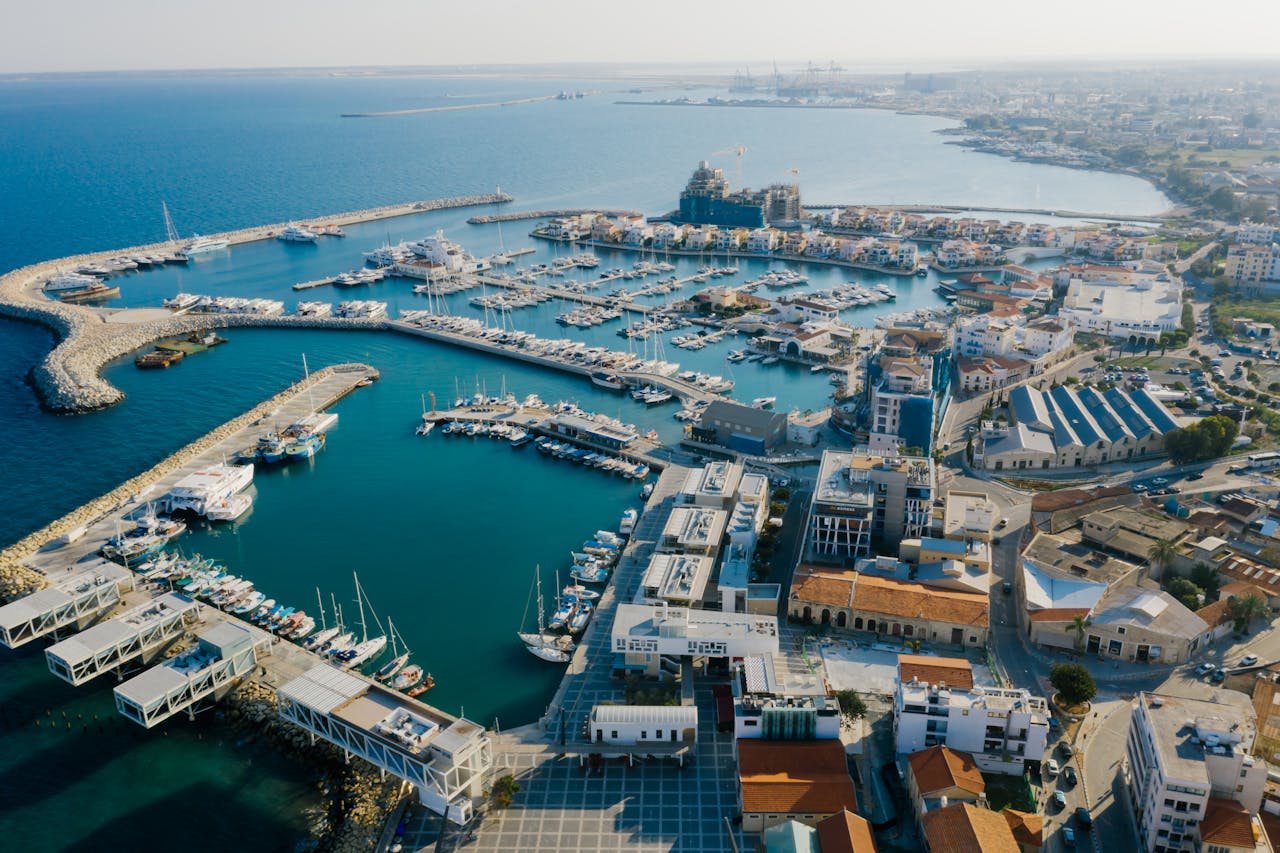
Cyprus property pricing is bifurcated by city. Limassol, the island’s financial and shipping hub and the magnet for international capital, commands the clear premium — prime and seafront product runs well above the national average — while Paphos, Larnaca, and Nicosia offer materially lower entry points. The €300,000 residency threshold is comfortably met across new-build stock in the secondary cities and at the lower end of Limassol’s pipeline.
The investable insight is on the supply side. Demand for residency-grade new-build product — the specific asset that qualifies for the permit — is concentrated, durable, and sourced from buyer channels (Levantine, Gulf, and broader Middle Eastern families) that are not price-elastic in the way domestic demand is. New supply of exactly this product is constrained by land, permitting, and construction capacity on a small island. When durable demand meets constrained supply for a narrowly defined asset, the pricing power sits with whoever controls the pipeline. This is a developer-side opportunity before it is a buyer-side one.
A second-home and lifestyle market
Underneath the residency mechanics is a genuine lifestyle market: a Mediterranean climate, established expatriate and retiree communities, a growing professional base anchored by Limassol’s shipping, fintech, and services sectors, and tourism that supports both seasonal rental yield and resale liquidity. The residency permit is the catalyst, but the underlying demand for the property is real independent of it — which is what separates a durable market from a pure visa-arbitrage play.
"As Europe’s investor-residency doors close one by one, Cyprus’s €300,000 route is now among the most accessible — and the only one where a Schengen re-rating still lies ahead, not behind."
EU Investor-Residency Routes, 2026
| Jurisdiction | Status | Effective threshold | Real estate qualifies? |
|---|---|---|---|
| Spain | Golden visa abolished (Apr 2025) | — | No |
| Portugal | Golden visa redirected; NHR ended (2024) | Funds/jobs only | No (since 2023) |
| Greece | Active, threshold raised | €800K high-zone / €400K | Yes |
| Cyprus | Active — permanent residency | €300K (+VAT), new-build | Yes |
Comparison is of investor-residency routes only; figures are positioning references, not legal advice. Programme terms change — confirm current rules before acting.
Where the Opportunity Is
CAC’s interest in Cyprus is not in selling visas; it is in the structural gap the residency demand creates. The qualifying asset — new-build residential that clears the threshold and suits the relocating-family buyer — is supply-constrained, and the most reliable way to participate is on the development side rather than the retail-buyer side.
That is the same logic that runs through CAC’s work elsewhere: rather than buying a finished unit at retail or a share in a blind pool, capital participates deal-by-deal in the asset itself, through a ring-fenced vehicle tied to a specific project. In Cyprus, that means co-investment alongside developers building residency-grade product for an identified buyer channel — capturing the developer margin that the supply constraint protects, with the residency demand underwriting absorption. The platform’s role is to curate those opportunities and structure the participation, not to manage a fund or advise on securities.
Risks and Positioning
No reroute is without its own closing risk. The clearest is policy: Cyprus has watched its neighbours raise thresholds and abolish programmes, and there is no guarantee its €300,000 route survives unchanged. The affordability politics that closed Spain’s door exist, in milder form, on every Mediterranean island. A buyer’s thesis that depends on the programme’s permanence is mispriced; a thesis that treats the current window as finite is not.
The Schengen catalyst is an expected value, not a certainty — accession could slip, and a permit’s value should be underwritten on its present terms, with Schengen as upside rather than base case. The buyer channel is concentrated: heavy reliance on Levantine and Gulf demand means regional shocks transmit directly into absorption. Post-2020 Cyprus also operates under heightened anti-money-laundering and due-diligence scrutiny — a legacy of the citizenship programme’s wind-down — which lengthens timelines and raises the bar on source-of-funds documentation. And while the euro removes currency risk for European capital, it adds translation risk for dollar- or dirham-based buyers.
These are reasons to structure carefully and to size the window honestly — not reasons to stand aside. They are, in fact, why the opportunity is available: a frictionless, risk-free version of this trade would already be priced.
Conclusion: The Window Before the Catalyst
Cyprus did not become attractive because it changed. It became attractive because everywhere else did. As the EU’s investor-residency doors closed across Spain, Portugal, and Greece, the capital that funded them did not vanish — it began looking for the next open door, and found one that is cheaper, euro-denominated, common-law, and carrying an unpriced Schengen option.
Doors in this market have a documented habit of closing. The ones that stay open longest are those where foreign capital is structurally woven into the economy — and Cyprus qualifies. But "longest" is not "forever," and the catalyst that would re-rate every permit is still ahead. For capital seeking a durable EU foothold with genuine asset value beneath the residency, and for participation on the developer side where the supply constraint creates the margin, the window is open now. The reroute has started. The pricing has not yet caught up.
Market analysis, not investment advice. Programme terms, thresholds, and timelines change — confirm current rules with qualified Cyprus counsel before acting.